Dr. Raphaël Nogier 2026 Class Syllabus
First Day
Morning
9:00-9:15: Welcome. Explanation of the course structure and objectives.
9:15-9:30: Definition of medicine. The role of doctors and healthcare professionals in the healthcare system. Medicine has three goals: to relieve pain, to restore impaired bodily functions, and to prevent disease.
9:30-10:30: History of auriculotherapy, including the discoveries of Paul Nogier, the creator of auriculotherapy. A review of the work of Hippocrates, Avicenna, Pierre-François Percy, Joseph Malgaigne, and Charles-Édouard Brown-Sequart.
10h30-11h00: Pause
11h-11h30: Embryology, anatomy, innervation of the auricle, with emphasis on the work of Jean Bossy and René Bourdiol.
11h30-12h: How were auricular maps constructed: French mapping, Chinese mapping.
12h12h30: Scientific work on auriculotherapy: INSERM report from France in 2014. WHO reports: Seoul, Geneva, Lyon, Guangzhou.
Afternoon
14h-15h00: The two kinds of points on the ear. Reflex points. Neuro-vascular points. How to detect them, how to treat them.
15h00-15h30: Concept of auricular somatotopy
15h30- 16h: pause
16h-16h30: discovery of the VAS (Vascular Autonomic Signal). Reminder on the work of Professeur René Leriche.
16h30-17h: The 5 steps taken by Paul Nogier to understand the VAS
17h-17h30: Physiological review of the pulse and arterial innervation
Second day
Morning
9h-9h30: study of autonomic nervous system: description
9h30-10h: study of autonomic nervous system: functioning
10h-10h30: link between the autonomic nervous system and the VAS
10h30-11h: pause
11h-11h30 Technic to take the pulse searching the VAS
11h-30-12h00: white test lamp. The SRI (sympathetic reactivity Index). Normal reaction
12h12h30: disruption of SRI. Physiological explanation. What to do when there is a disruption of SRI. Clinical examples: chronic fatigue, post COVID, nervous depression, digestive functional diseases, sympathetic pains, immunity disorders.
Afternoon
14h00-14h30: White lamp test: Exhaustion phenomenon. Physiological explanation
14h30-15h00: Exhaustion phenomenon and tooth foci
15h00- 15h30: Exhaustion phenomenon. Disruptive scars. Functional diseases, chronic urticaria,
15h30- 16h00: Pause
16h00-16h30: How to treat disruptive scars on the ear
16h30-17h00: special case of organ scars: liver, pancreas, prostate. How to treat a patient with chemotherapy:
17h00-17h30: Clinical examples
Third day
Morning
Study of ear localizations
9h-10hh30:
Endodermic localizations on the ear:
concha
Digestive tract
Liver
Pancreas
Gall bladder
Lung and bronchus
10h30-11h: pause
11h-12h30: Principal ectodermic localizations: helix and lobule. How to treat the PTSD with ear points.
Afternoon
14h-16h
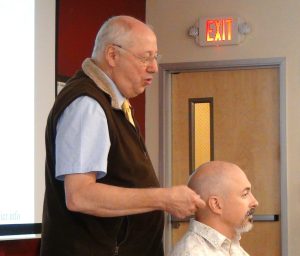
Demonstrations with the VAS and the ear